
How to Choose the Right Solar Power Bank
Learn how to choose solar power bank options that actually work off-grid. Compare built-in panels, foldout arrays, battery capacities, and realistic charging speeds.
Quick answer To pick the right solar charger, choose based on your actual off-grid power needs rather than marketing promises. Single-panel power banks are best treated as slow emergency backups, while multi-panel foldout kits or separate solar panels are required if you want to recharge your devices daily using direct sunlight.
Heading off the grid with a phone, GPS unit, or headlamp requires a reliable energy source, but marketing claims around portable solar chargers can be misleading. Many budget solar power banks take over a week of continuous sunlight to fill their internal batteries, leaving unprepared hikers and campers stranded with dead electronics.
Knowing how to choose solar power bank options that fit your specific trip length, pack weight, and device setup will save you money and keep your gear running when outlets are out of reach.
Key takeaways
- Single-panel solar power banks only provide emergency trickles (100–300 mA) and can take 50 to 100+ hours of direct sun to fully recharge.
- Foldout 4-panel arrays or standalone solar panels (delivering 1A to 2A+ in direct sunlight) are necessary for daily solar recharging.
- Always calculate your total device needs in Watt-hours (Wh) to size your power bank for laptops, drones, or multi-day smartphone use.
- Prioritize modern USB-C Power Delivery (PD) over legacy micro-USB ports for faster wall charging and dual-direction power transfer.
Integrated Solar vs. Foldout Solar Panels: What Actually Works
When shopping for solar chargers, you will encounter two main designs: single-panel integrated power banks and multi-panel foldout arrays. Understanding the physical limits of each solar cell setup is essential before making a purchase decision.
Single-Panel Integrated Power Banks
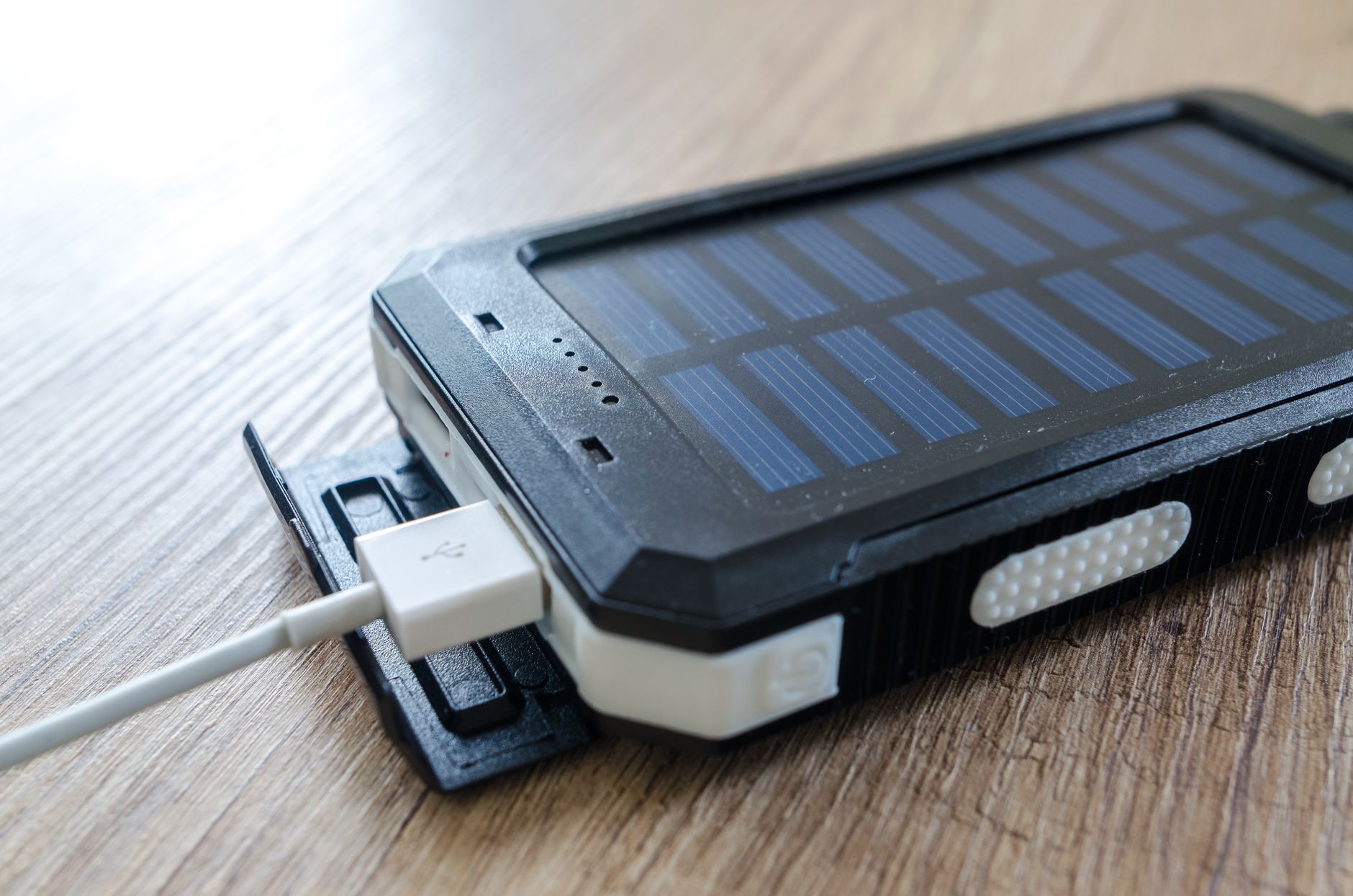
Single-panel units like the Renogy E.POWER 10,000 mAh (37 Wh) or the BLAVOR PN-W12 (20,000 mAh) feature a small solar cell fixed to one side of the battery casing. Because the surface area of a single phone-sized panel is tiny, light harvesting is extremely limited. In ideal weather conditions, a single panel produces only 1.5 to 2 Watts of power.
These compact power banks are built primarily to be charged at home from a wall outlet before your trip. The single solar panel serves as an emergency passive top-up feature if you get lost or experience an extended power outage. They are lightweight, fit easily into a backpack pocket, and often feature rugged, splash-resistant shells.
Foldout Solar Panels and Hybrid Systems
Foldout solar power banks, such as the ADDTOP 25,000 mAh solar charger or the SOARAISE 48,000 mAh battery bank, use four or five canvas-hinged solar panels that unfold into a much larger surface area. By expanding the solar collection area fourfold, these arrays can generate up to 5 to 6 Watts (roughly 1A in direct sunlight).
If you prefer complete flexibility, separate panel-and-battery setups like the Goal Zero Venture 35 paired with a Goal Zero Nomad 10 panel offer higher durability. Independent panels can be mounted to a tent or backpack while keeping the delicate battery safely tucked away inside a shaded pocket.
Solar Cell Efficiency: Monocrystalline vs. SunPower
Not all solar cells convert light into electricity at the same rate. Budget power banks often use standard monocrystalline silicon cells with conversion efficiencies between 17% and 20%. While functional in direct daylight, monocrystalline panels lose significant output under overcast skies or tree canopy shade.
Higher-end solar setups utilize SunPower solar cells, which feature a back-contact structure that boosts energy conversion efficiency to 22%–24%. SunPower cells handle partial shading and ambient daylight much better, making them ideal for outdoor enthusiasts traveling through dense forests or variable weather.
Understanding Battery Capacity: How Many Charges Do You Need?

Photo by Dajana Reçi on Pexels
Battery capacity is measured in milliamp-hours (mAh) or Watt-hours (Wh). Modern smartphone batteries range from 2,000 mAh to 5,000 mAh. However, energy conversion is not 100% efficient; resistance and voltage conversion from the internal 3.7V battery cell up to 5V (or higher) USB standards cause roughly 20% to 30% energy loss during transfers.
| Power Bank Capacity | Energy (Watt-Hours) | Approximate Smartphone Recharges | Best Use Case |
|---|---|---|---|
| 10,000 mAh | ~37 Wh | 1 to 2 charges | Lightweight day hikes, weekend minimalism |
| 20,000–25,000 mAh | ~74–92.5 Wh | 3 to 5 charges | Multi-day backpacking, paired emergency backup |
| 40,000–48,000 mAh | ~148–177.6 Wh | 8 to 11 charges | Base camp power, multi-person emergency prep |
Sizing Guidelines for Larger Off-Grid Gear
If you need to power gear beyond a basic phone—such as DSLR camera batteries, action cameras, drones, or laptops—you must calculate total energy consumption using Watt-hours (Wh). Multiply the device's battery voltage by its amp-hour rating, or check the label on the device power brick.
- Action Cameras / Headlamps: 4 Wh to 12 Wh per charge. A 10,000 mAh bank easily keeps these small devices running for days.
- DSLR / Mirrorless Camera Batteries: 14 Wh to 18 Wh per charge. Drone batteries (like camera quadcopters) take 30 Wh to 40 Wh per flight.
- Laptops: Standard ultrabook batteries range from 50 Wh to 80 Wh. Charging a laptop once requires a power bank of at least 20,000 mAh (74 Wh) equipped with high-wattage USB-C Power Delivery (45W to 65W output minimum).
Tip: You can measure your gear's exact energy draw using an inline USB monitor or a Kill A Watt meter at the wall while charging, allowing you to build an accurate off-grid power budget.
Solar Charging Speeds: Realistic Expectations vs. Marketing Claims
The biggest point of frustration for buyers is expecting a single solar panel to recharge a large battery overnight. The math explains why this is physically impossible.
A typical 20,000 mAh battery holds approximately 74 Watt-hours of energy. A single built-in solar panel collecting direct overhead daylight generates about 1.5 Watts per hour. Accounting for real-world inefficiencies, filling that 20,000 mAh bank from zero using only its single built-in solar panel takes upwards of 50 to 70 hours of pure, uninterrupted sunshine.
By contrast, a 4-panel foldout solar array generating 6 Watts takes roughly 15 to 20 hours of sunlight. Independent 10W to 28W panels (such as the Goal Zero Nomad 10 or BigBlue 28W) can completely refill a medium-sized power bank in a single full day of clear sunshine.
Key Specs That Matter: Ports, IP Ratings, and Passthrough Charging
Input and Output Port Selection
Fast charging standards make a dramatic difference when preparing gear before a trip. Look for banks offering 18W (or higher) USB-C Power Delivery (PD) and Quick Charge 3.0 (QC3.0), such as the BLAVOR PN-W12. Fast USB-C input lets you refill a massive 20,000 mAh bank from a wall outlet in 5 to 6 hours instead of 14 hours over micro-USB.
Warning: Be careful when evaluating high-capacity budget models. For example, while the ADDTOP 25,000 mAh unit offers a useful 4-panel foldout array, it relies on legacy micro-USB input charging and standard dual USB-A outputs. It lacks fast USB-C Power Delivery, meaning wall recharging times and output charging to modern devices will be significantly slower.
Durability and Weather Resistance
If your solar battery will hang off a backpack, dust and water ingress protection is mandatory. Check the manufacturer's IP rating code:
- IP64 Rating: Fully dust-tight and protected against splashing water from any direction (e.g., Renogy E.POWER 10,000 mAh).
- IPX5 Rating: Protected against low-pressure water streams and rain showers, as well as dust and shock (e.g., BLAVOR PN-W12).
For more details on how ingress protection testing works for outdoor electronics, read our comprehensive guide on IP ratings explained.
Passthrough Charging and Kickstands
Passthrough charging allows the internal battery to receive power from the solar panels while simultaneously outputting power to your phone. Additionally, built-in kickstands or mounting loops are vital; angling panels at a 45-degree angle toward the sun increases energy harvest by up to 30% compared to laying panels flat on the ground.
Which Solar Charger Is Right for Your Activity?
Backpacking and Thru-Hiking
Every ounce matters on long trail hikes. Carrying heavy 40,000+ mAh banks adds unnecessary pack weight. Choose a compact 10,000 mAh single-panel bank or pair a light 10,000 mAh power bank with a foldable 10W panel attached to the top of your pack.
Car Camping and Multi-Day Base Camps
Weight is less of a concern when driving to a campsite. Multi-panel foldout power banks (25,000 mAh to 48,000 mAh) or standalone 28W foldable solar arrays allow you to keep multiple phones, headlamps, and camera gear charged indefinitely.
Emergency Preparedness and Outage Backup
For home emergency kits during storms or winter grid outages, versatility matters most. Hybrid models—such as the BLAVOR 20,000 mAh Hand Crank Solar Power Bank featuring built-in charging cables, emergency flashlights, and hand-crank generation—provide multi-layered backup when sunlight or grid power is unavailable.
Common Mistakes to Avoid
- Relying on single panels for daily power: Expecting a small single-panel charger to act as your main energy source in the woods. Always treat single panels as backup emergency trickle chargers.
- Forgetting to charge before leaving: Heading into the wild with an empty battery bank expecting solar to top it up instantly on day one. Always fully charge from the wall before your trip.
- Laying panels flat in the shade: Placing solar chargers flat on damp soil under tree canopy coverage. Always angle panels directly toward the sun using kickstands or carabiners.
- Ignoring pack weight ratios: Buying massive 40,000 mAh power banks for high-mileage ultralight hikes where smaller 10,000 mAh units are sufficient.
Pros
- Provides emergency off-grid power replenishment when wall outlets are unavailable.
- Foldout arrays provide genuine daily self-sustaining energy in clear sunlight.
- Rugged designs include flashlights, carabiner mounts, and splash protection.
Cons
- Single-panel designs take days to recharge internal batteries from solar alone.
- Heavy multi-panel units add noticeable weight to backpacking kits.
- Solar collection efficiency drops dramatically under heavy cloud cover or shade.
Bottom line For standard weekend trips or light emergency backup, a compact 10,000 mAh to 20,000 mAh power bank with USB-C PD is the practical choice. If you require true off-grid energy independence for multi-day trips, invest in a 4-panel foldout unit or a separate 10W–28W solar panel setup utilizing high-efficiency SunPower cells.
FAQ
Can a solar power bank fully charge my phone using just sunlight?
Yes, provided the internal battery inside the power bank already contains stored energy. However, if the power bank battery is completely dead, relying on a single built-in solar panel will take several hours of sunlight just to gather enough energy for a 10% to 20% phone charge.
How long does it take to charge a solar power bank in direct sun?
A single-panel power bank (10,000 to 20,000 mAh) takes between 50 and 100 hours of direct sun to charge fully. A 4-panel foldout solar power bank takes roughly 15 to 25 hours, while a dedicated 10W–28W standalone solar panel can refill a power bank in 6 to 10 hours.
Are small solar power banks with built-in panels worth it?
They are worth buying if you view them as standard durable power banks with an emergency solar backup feature. They should not be purchased if you expect the single solar panel to serve as your primary daily charging method while camping.
What size solar charger do I need for a 3-day camping trip?
For a standard weekend trip charging one phone and a headlamp, a 10,000 mAh to 20,000 mAh power bank charged from the wall before leaving is typically enough without relying heavily on solar power. If managing multiple devices or cameras, add a 4-panel foldout charger or 10W standalone panel.
Can you leave a solar power bank in a hot car?
No. Leaving lithium-ion battery banks on a car dashboard under direct sunlight can cause extreme heat buildup (exceeding 140°F / 60°C), degrading battery life, swelling the casing, or creating a serious fire hazard.
Sources
Facts in this article were checked against these pages on November 8, 2026:
- solarpowercee.com
- 6 Best Solar Power Banks (2026) (poweroutage.us)
- How to Choose the Right Portable Solar Power for You (tacticaldistributors.com)
- Best Portable Solar Chargers | Tested & Ranked (outdoorgearlab.com)
- How to Pick a Solar Power Bank Charger | Buyer's Guide (unitetolight.org)
- Best Solar Power Banks of 2026, Tested and Reviewed (outdoorlife.com)
How we researched this: this guide is based on current manufacturer information and reputable sources, listed in the Sources section above, and is updated when things change. Read our editorial policy.
Content Writter


Comments
No comments yet — be the first to share your thoughts.